

In the traditional landscape of finance, calculus has long been king. Students spend countless hours mastering derivatives and integrals to understand continuous growth and interest rates. However, as the global economy shifts toward high-frequency trading, blockchain technology, and complex algorithmic modeling, a different branch of mathematics is emerging as the true “secret weapon” for aspiring professionals: Discrete Mathematics. Unlike calculus, which deals with continuous change, discrete math focuses on distinct, separated values. This makes it the native language of the computers and algorithms that now run Wall Street and the City of London.
For a student navigating the rigors of a modern degree, the transition from theoretical numbers to practical application can be daunting. Often, the workload becomes so intense that seeking specialized help with finance homework becomes a strategic move to ensure that these complex connections are fully understood rather than just memorized. Mastery of these concepts doesn’t just help you pass an exam; it reshapes how you perceive market structures and risk.
The Intersection of Logic and Capital
At its core, discrete mathematics is about logic and set theory. In finance, every decision is a logical “if-then” statement. If a specific market indicator hits a certain threshold, then a series of trades are triggered. Understanding formal logic allows a finance major to audit these algorithmic “trees” for errors. When you study graph theory—a major component of discrete math—you aren’t just looking at dots and lines; you are looking at the architecture of payment networks and the flow of contagion in a financial crisis.
Why “Discrete” Matters in a Digital Market
Most financial models used in classrooms assume markets move in smooth, continuous curves. In reality, markets move in discrete “ticks.” Prices jump from one value to another. Discrete math provides the tools to model these jumps. This is why recruiters at top-tier quantitative hedge funds often prioritize students who can demonstrate a deep understanding of combinatorics and probability over those who only know standard business math.
Mapping Math to Finance: A Comparison Table
To see how these two worlds collide, look at how specific mathematical branches fuel real-world financial functions:
| Discrete Math Concept | Financial Application | Career Benefit |
| Graph Theory | Analyzing Credit Networks | Risk Management Specialist |
| Combinatorics | Option Pricing & Derivatives | Quantitative Analyst (Quant) |
| Number Theory | Cryptography & FinTech Security | Blockchain Developer |
| Probability Theory | Risk Assessment & Insurance | Actuary |
| Set Theory | Portfolio Diversification | Asset Manager |
Overcoming the Learning Curve
The challenge for most undergraduate students is that discrete math feels “abstract.” It doesn’t look like the math you did in high school. You are dealing with proofs, logic gates, and modular arithmetic. It is easy to feel overwhelmed when these concepts are suddenly applied to a high-stakes finance project.
If you find yourself stuck on the logic of a particular proof or the application of a probability model, remember that you don’t have to struggle in isolation. Utilizing the experts at MyAssignmentHelp to do my math homework can be a game-changer for maintaining your GPA while you focus on the broader implications of your finance degree. By seeing how professionals structure these mathematical arguments, you learn the “language” of proofs much faster than you would by staring at a textbook alone.
Combinatorics: The Art of Counting Risk
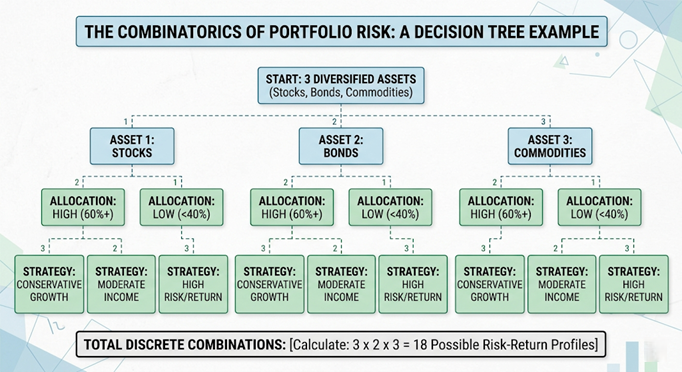
One of the most powerful tools in a finance student’s arsenal is combinatorics—the study of counting, arrangement, and permutation. Why does this matter for money? Consider a portfolio manager trying to understand the various ways 10 different assets can be combined to reach a specific risk-return profile. The number of combinations is staggering. Discrete math provides the formulas to calculate these possibilities efficiently, allowing for better stress-testing of portfolios.
Cryptography and the Future of Money
We cannot discuss modern finance without mentioning cryptocurrency and decentralized finance (DeFi). The security of every digital transaction relies on prime numbers and modular arithmetic, both of which are foundational to number theory in discrete math. Finance majors who understand the underlying “math of trust” are significantly better positioned to lead in the FinTech sector than those who see crypto as a black box.
Developing an Algorithmic Mindset
The primary reason discrete math is a secret weapon is that it teaches you how to think like a programmer without necessarily writing code. It forces you to break down massive problems into smaller, finite parts. In a corporate boardroom, the ability to decompose a complex merger or acquisition into a logical flow of discrete steps is an invaluable skill. It reduces “noise” and focuses on the structural reality of the deal.
Conclusion: Future-Proofing Your Career
The financial world is no longer just about “suits” and spreadsheets; it is about data, logic, and discrete structures. By embracing the challenge of discrete mathematics, you aren’t just fulfilling a credit requirement. You are building the cognitive infrastructure needed to thrive in an era where finance is driven by code. The road to the first page of the financial world is paved with logic—make sure your foundation is solid.
Frequently Asked Questions (FAQ)
1. Is discrete math harder than calculus for finance students?
Ans: It isn’t necessarily harder, but it is different. While calculus is about “how fast” things change, discrete math is about “the logic” behind the change. Most students find it more intuitive once they see its application in computer logic and probability.
2. Can I get a job in finance without knowing discrete math?
Ans: Yes, traditional roles in retail banking or accounting may not require it. However, if you want to enter high-paying fields like FinTech, Quantitative Analysis, or Algorithmic Trading, discrete math is essential.
3. How does set theory apply to my finance degree?
Ans: Set theory is used to categorize data. In finance, this is vital for segmenting markets, defining asset classes, and creating diversified portfolios where assets do not “overlap” in their risk categories.
4. Why is graph theory mentioned in relation to financial crises?
Ans: Graph theory maps connections. By looking at a financial system as a “graph,” analysts can see which banks or institutions are “nodes” that are too connected. If one node fails, graph theory helps predict which other nodes will be pulled down with it.
5. What is the best way to study these topics if I am struggling?
Ans: Focus on the relationship between the math and the money. Don’t just solve equations; ask how that equation changes a profit and loss statement. Using professional academic resources can also help clarify the “why” behind the “how.”
About the Author
Mark Hales is a Senior Academic Consultant and Lead Content Strategist at MyAssignmentHelp, specializing in the intersection of quantitative mathematics and global financial systems. With over a decade of experience in the academic support industry, I focus on helping undergraduate students bridge the gap between complex theoretical frameworks and real-world professional applications.
